So here I sit at my computer finally writing a long overdue blog post for English class. I ask myself the same questions every week; first: "What post are we on?" "Or wait, is it a comment week?"
I then tell myself: "Gee, maybe I should actually write this post tonight, after I check Tumblr."
A week of procrastination later: "Why didn't you catch up? Now you're two posts behind!"
I then justify in my head: "I will write one when the spirit gives me an idea worth writing about..."
I take that advice to heart, because I value this assignment to be interesting and not "phoned in" as some would say. I take this same advice in song writing; I have procrastinated writing music for about four years I think, always saying the time will come when I will be inspired and then the music will flow free. The time has finally come, I am now heavily working on writing an album to be done by summer with my boyfriend; who practically shits out music because he's amazing like that and that's job. I've been waiting for someone who can put music to my lyrics, and piece together the little bits of music I did write. Teddy is that guy, and he has taught me the secret to writing and that is to let go and let it happen, much like this post. So the point of this post is to explain why songwriting is so damn hard.
Like anything creative you're going to stare into the abyss of nothingness waiting for a while to get started. A good tip that I've taken far too long to listen to is write the music first. A lot of your lyric inspiration will need to not only fit the mood of the music, and the meter, but it must reside in the music. A lot of times the instrumentation will help you find the words needed to say, maybe the music will take you to a memory you will write about. Since we've all written short stories and I know a number of you want to write novels, you can think of this as setting your..well...setting first.
Next you need to wait for a lyric to hit you, once you've picked a mood and topic. Don't automatically think that the lyric: "I've roamed amongst the Earth with my eyes closed and heart open." Needs to be the first line, or even the chorus, maybe it's the last lyric or the 7th I don't know!
Now here comes the part I hate the most, once you think you've finished writing beautiful poetry to go to your instrumentation you are going to read it back and want to destroy it. DON'T! A lot of times you'll find amazing lyrics and some that make you cringe, the trick is to not destroy but enhance. I've thrown out so much of my work when I was younger, and regretted it. Some of the lyrics I wrote at 12 are much more inspired and poetic than what I wrote at 15. I regret throwing them out so bad! YES THEY ARE EMBARASSING, YOU ARE GOING TO FEEL LIKE YOU'RE READING BACK YOUR OLD AIM PROFILE BUT....but....it is just that. It's immature, it has to grow. You're going to think your lyrics are cheesy, shitty, awful, I always do...but I find that most are. You won't get better without writing in route, and you can't force it out, it'll come out when it's ready.
So I am currently looking over at my guitar pick I ripped my room apart to find, and about to get up to write some lyrics to this song I wrote today. I know it's going to be an odd experience, but it has to be done. Hopefully the lyrics won't be as cheesy as I am expecting them to be. Maybe blog post 9 will be the lyrics I wrote...or maybe not, I don't need to risk having them stolen from me >:) Blog post 9 will then deal with copyright law suits.
Tuesday, February 4, 2014

Tuesday, January 7, 2014
My Theory on why Sequels and Remakes Never Work
So my seventh blog post is a little late, and probably won't get comments but I feel like ranting. As I sit here I am listening to the second cover of "No Quarter" by Led Zeppelin that I heard in the past week-Tool made an epic one and I'm currently hearing The Flaming Lips version I'm not quite digging as much. This sparked thought about covers of songs which led me to think of sequels to movies and remakes.
Probably the most famous debate I've been hearing lately in regards to sequels and remakes is peoples ideas about the "Evil Dead" so called "remake" that came out last year. So many people were up in arms about it and thought it didn't do justice to the series however; it wasn't meant to be a dead ringer; it was meant as a tribute really which is what "covers" really are. Some bands(and movie directors) want to replicate the work as best as they can with what they have to offer-this is more common in music. Others want to do it their own way with modern technology-very common with directors such as Rob Zombie's "Halloween". Sometimes replicas of classic movies are not received well, such as the remake of "Clash of the Titans" while others are actually praised, such as "The Parents Trap".
In regards to sequels I am once again using "Star Wars" as my example regarding sequels. Being that Lucas started the series with episode 4 it only called for a 1 2 and 3. We all can agree that episodes 1 and 2 were not great, but 3 (the most recent) was awesome, Why? Plot! 1 and 2 were boring and really only there to build up to Darth Vader becoming Darth Vader, but that was their purpose! I personally wasn't a fan of the incoming use of CGI in 1 and 2 but hey, it was the new millennium so that was cool then I guess. I think there's something to be said for old school special effects but what are you gonna do? So Star Wars was a rough ride with sequels considering episode 3 was a hit but 1 and 2 weren't, but then you have a series that just won't quit and really should like Paranormal Activity. Sequels stop working when you tire out a plot or release them too frequently- like the "Alvin and the Chipmunks" movies, "Shrek" did well with their sequels because they timed the releasing of them properly even though the third (or was it the fourth?) was kind of questionable. Going back to "Paranormal Activity", I was shocked they even did a second one! I will admit I saw the third and fourth and wasn't too upset but I think it's going too far, how much more can you elaborate on a haunting? The first movie was awesome because of how low budget it was but now that it's becoming a regular series they're now "faking" the low budget thing sucking the appeal dry and it's STUPID!
So why do some work and others don't? In sequels it's pretty cut and dry, sequels work well when you create a reason to have one like Star Wars in conjunction with timing. If you release a sequel the year after the first movie it may be too soon and will tire out the whole franchise. It's very easy to tire out a plot or release a sequel that is soley relying on the success of the original movie. As for remakes? Remakes work best when you either create a new element that sells the movie almost as if it wasn't a remake at all. They also work if they are a proper tribute and honor the original well. If you make a remake and it retains no soul of the original or isn't unique in it's "new take" on the original. I personally enjoyed Rob Zombies remake of Halloween because it had a gritty, sleazy, modernness to it that sold it well. It wasn't too different from the original in plot at all or the intensity, it was exactly as it was intended to be, the same movie as if it were released now.
I don't see remakes and sequels as cop outs if they're done by renowned and respected directors with good intentions. It's hard to be original in this day and age so I see how remakes look like the easy way out but creating one is delicate work because you have purist fans out there who will be very tough critics. I have my eye on Disney and what they're going to do to my Star Wars trilogy.
Probably the most famous debate I've been hearing lately in regards to sequels and remakes is peoples ideas about the "Evil Dead" so called "remake" that came out last year. So many people were up in arms about it and thought it didn't do justice to the series however; it wasn't meant to be a dead ringer; it was meant as a tribute really which is what "covers" really are. Some bands(and movie directors) want to replicate the work as best as they can with what they have to offer-this is more common in music. Others want to do it their own way with modern technology-very common with directors such as Rob Zombie's "Halloween". Sometimes replicas of classic movies are not received well, such as the remake of "Clash of the Titans" while others are actually praised, such as "The Parents Trap".
In regards to sequels I am once again using "Star Wars" as my example regarding sequels. Being that Lucas started the series with episode 4 it only called for a 1 2 and 3. We all can agree that episodes 1 and 2 were not great, but 3 (the most recent) was awesome, Why? Plot! 1 and 2 were boring and really only there to build up to Darth Vader becoming Darth Vader, but that was their purpose! I personally wasn't a fan of the incoming use of CGI in 1 and 2 but hey, it was the new millennium so that was cool then I guess. I think there's something to be said for old school special effects but what are you gonna do? So Star Wars was a rough ride with sequels considering episode 3 was a hit but 1 and 2 weren't, but then you have a series that just won't quit and really should like Paranormal Activity. Sequels stop working when you tire out a plot or release them too frequently- like the "Alvin and the Chipmunks" movies, "Shrek" did well with their sequels because they timed the releasing of them properly even though the third (or was it the fourth?) was kind of questionable. Going back to "Paranormal Activity", I was shocked they even did a second one! I will admit I saw the third and fourth and wasn't too upset but I think it's going too far, how much more can you elaborate on a haunting? The first movie was awesome because of how low budget it was but now that it's becoming a regular series they're now "faking" the low budget thing sucking the appeal dry and it's STUPID!
So why do some work and others don't? In sequels it's pretty cut and dry, sequels work well when you create a reason to have one like Star Wars in conjunction with timing. If you release a sequel the year after the first movie it may be too soon and will tire out the whole franchise. It's very easy to tire out a plot or release a sequel that is soley relying on the success of the original movie. As for remakes? Remakes work best when you either create a new element that sells the movie almost as if it wasn't a remake at all. They also work if they are a proper tribute and honor the original well. If you make a remake and it retains no soul of the original or isn't unique in it's "new take" on the original. I personally enjoyed Rob Zombies remake of Halloween because it had a gritty, sleazy, modernness to it that sold it well. It wasn't too different from the original in plot at all or the intensity, it was exactly as it was intended to be, the same movie as if it were released now.
I don't see remakes and sequels as cop outs if they're done by renowned and respected directors with good intentions. It's hard to be original in this day and age so I see how remakes look like the easy way out but creating one is delicate work because you have purist fans out there who will be very tough critics. I have my eye on Disney and what they're going to do to my Star Wars trilogy.
Wednesday, December 4, 2013
Most recently I have began dating a professional musician; besides doing the typical gigging and being a session artist he also scores video games-he writes the music you hear in the background of mobile media games. His job requires him to write around 40 hours of a music for each project and he doesn't like to repeat songs so how do you come up with all of that music? And not repeat?
Naturally watching game film and imagining what music you would expect to hear in each world during each task would give you ideas but that still leaves much to be desired.
As corny as it sounds I was told his most recent method to attaining to much inspiration-I'm his muse.
(cue all the awwwws and gagging noises and blah blah blah)
Every great artist at one point or another has a muse whether it's their significant other, someone they worship from afar, a family member and maybe even just an idea. Jim Morrison had Pamela Courson, Dante had Beatrice, Chagall had Bella, and Patti Boyd inspired the Beatles as well as Eric Clapton and Valerie Bertenelli inspired David Lee Roth. We all remember from the Odyssey how the muses were three goddesses of the arts. Since then the term muse has evolved to mean any source of great inspiration. Muses play a great role in the arts; unyielding love is quite an emotion and can be joyous, sad, tortuous, and can drive quite a plotline which is why almost every story involves love right?
I used to be really annoyed and ticked off at how everything had to have some type of theme of love but once you experience how all consuming it is it's hard to NOT see why. Love is an emotion we all experience at some point in our lives no matter how black and dull you believe your soul is. We may not all experience the driving inspiration of a muse but a lot of us will, and again, a muse doesn't have to be your significant other.
Thursday, November 14, 2013
Nursery Rhymes and Mutilation
So as I sit here at my laptop realizing my blog post is 2 days late I search the corners of my mind for inspiration to write about. My rabbit is in the cage beside me eating like a horse and it's very loud but comical because he's a bunny and he's so obnoxious when he eats and he's a bunny and it's cute. I glance over at him and admire his cute little flufflebuttle (proper rabbit anatomy term for butt) and his luxurious yet subtle poofloof(proper rabbit anatomy term for tail). I start to sing this stupid little nursery rhyme like song I wrote for him:
"You have a fluffy buttle, yes you have a fluffy buttle,
bunnies have fluffy buttles and you have a fluffy buttle,
who has a cute little poof loof, you have a cute little poof loof,
and if that poof loof gets cut off, you still have a fluffy buttle..."
There are more verses but that's the important one, now why did I sing about my rabbit having his tail cut off? Well, his "cousin" Rella -who's my friend Julie's bunny- used to live in a chicken coop; Rella only has a half a tail. Her tail was bit off by one of the chickens when she was younger-Rella still has a fluffy buttle.
I sang about his tail getting cut off for another reason too, do you remember the famous nursery rhyme game thing "Ring Around the Rosey?" We know it was about the plague yes? If you don't now you do.

"Ring around the rosie
pocket full of posie
ashes, ashes, we all fall down..."
Most nursery rhymes and children's stories are pretty gruesome and morbid. "Rock-a-bye baby" has the cradle falling from the tree, and Cinderella's sisters cut their feet off to feet in the glass slipper, that's not rated G! Why are these rhymes-and the Grimm Faerie tales- that way??

Probably because us humans are morbid and many of the popular nursery rhymes are derived from history. Even at that though, why do we sing them to our kids I just don't understand?
I guess that's why we're so creeped out by nursery rhyme sounding music in horror movies, it's just so innocent that it's creepy. So bizarre. What do you think?
"You have a fluffy buttle, yes you have a fluffy buttle,
bunnies have fluffy buttles and you have a fluffy buttle,
who has a cute little poof loof, you have a cute little poof loof,
and if that poof loof gets cut off, you still have a fluffy buttle..."
There are more verses but that's the important one, now why did I sing about my rabbit having his tail cut off? Well, his "cousin" Rella -who's my friend Julie's bunny- used to live in a chicken coop; Rella only has a half a tail. Her tail was bit off by one of the chickens when she was younger-Rella still has a fluffy buttle.
I sang about his tail getting cut off for another reason too, do you remember the famous nursery rhyme game thing "Ring Around the Rosey?" We know it was about the plague yes? If you don't now you do.
"Ring around the rosie
pocket full of posie
ashes, ashes, we all fall down..."
Most nursery rhymes and children's stories are pretty gruesome and morbid. "Rock-a-bye baby" has the cradle falling from the tree, and Cinderella's sisters cut their feet off to feet in the glass slipper, that's not rated G! Why are these rhymes-and the Grimm Faerie tales- that way??
Probably because us humans are morbid and many of the popular nursery rhymes are derived from history. Even at that though, why do we sing them to our kids I just don't understand?
I guess that's why we're so creeped out by nursery rhyme sounding music in horror movies, it's just so innocent that it's creepy. So bizarre. What do you think?
Tuesday, November 5, 2013
The Language of the Future, an appropriate post for the 5th of November.
This idea for my very late blog post came to me, this idea is well worth the one week overdue-ness of this post. I have read "1984" about as many times as I've read "The Perks of Being a Wallflower," "Go Ask Alice," and watched "The Big Lebowski." For those of you who don't know me personally that would be upwards of about 20 times (this is a hyperbole)...((so more like 10)). In George Orwell's dystopian novel "1984" -just read the link to know the plot that's what it's there for-they use this new language-called newspeak-, that changes yearly just about, that is extremely basic in order to inhibit and discourage free thought. There is an entire science behind this language that you can find in the back of my mangled copy of "1984", I will explain some of it here...or I would if I hadn't lent my book to my ex-boyfriend. Anyway I was able to find some of it here...which I will explain below.


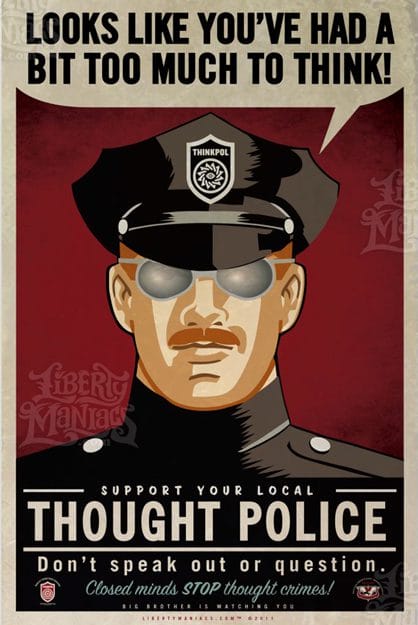


The language follows the same grammatical rules as English except much more compressed. Many synonyms and antonyms deemed unnecessary are eliminated as well as any concepts and ideas that the Party disapproves of. "The aim of Newspeak is to remove all shades of meaning from language, leaving simple concepts (pleasure and pain, happiness and sadness, goodthink and crimethink) that reinforce the total dominance of the State. Newspeak root words serve as both nouns and verbs, further reducing the total number of words; for example, "think" is both noun and verb, so the word thought is not required and can be abolished. The party also intends that Newspeak be spoken in staccato rhythms with syllables that are easy to pronounce. This will make speech more automatic and unconscious and reduce the likelihood of thought." Another interesting fact that I found is: "Newspeak's contracted forms, such as Ingsoc and Minitrue, are inspired by the Russian syllabic abbreviations used for concepts relating to the government and society of the USSR, such as politburo, Comintern, kolkhoz (collective farm) and Komsomol (Young Communists' League), many of which found their way into the speech of Communists in other countries."
"In addition, words with negative meanings are removed as redundant, so "bad" becomes "ungood". Words with comparative and superlative meanings are also simplified, so "better" becomes "plusgood", and "best" becomes "doubleplus good". Intensifiers can be added, so "great" became "plusgood", and "excellent" and "splendid" become "doubleplus good". This ambiguity between comparative/superlative forms and intensified forms is one of the few examples of ambiguity in Newspeak."
"In addition, words with negative meanings are removed as redundant, so "bad" becomes "ungood". Words with comparative and superlative meanings are also simplified, so "better" becomes "plusgood", and "best" becomes "doubleplus good". Intensifiers can be added, so "great" became "plusgood", and "excellent" and "splendid" become "doubleplus good". This ambiguity between comparative/superlative forms and intensified forms is one of the few examples of ambiguity in Newspeak."
Wikipedia did a nice job of explaining Newspeak and how it's formatted so I figured I'd just paste it there.
So why did I decide to mention Newspeak, a fictional language in an Orwell novel?
I constantly hear all the time about people griping over vocabulary sheets and wondering why we have so many words for the same exact thing. Naturally, writers love it because you can add color and flavor to your writing and because some words can take the place of 5. Education is power, and having a large vocabulary not only makes you sound smart but frees you because you have the ability to express independent thought and self expression. Newspeak exists to rob the population of their ability to have that power, which is the point Orwell was creating with that language. When I first read the book I never quite understood the concept of Newspeak and why it was so scary, I was disturbed by it but it took me a few years to understand just how serious that is.
We all know our language is shrinking because certain eloquent words have become less common and instead of have been replaced by "basic bi**" vocabulary and abbreviations such as YOLO, Facebook lingo such as "friending and unfriending" "liking and unlking" having an amount of "likes" on something? Sound like Newspeak? Everyday we are slowly becoming a monotonous culture losing our freedom of expression simply because we are not using it. I am on the verge of a political rant which is no appropriate right now so I will leave you with that to think about. Remember, language is power! Don't take it for granted.
p.s.-HAPPY GUY FAWKES DAY EVERYBODY!
Remember, remember, the 5th of November...
Tuesday, October 15, 2013
Let's Talk about Star Wars...
 To be completely honest I had NO IDEA what I was going to write about this week, but Star Wars seemed like a good direction to head in. I guess a good place to start in talking about Star Wars is why is it such a big deal? Well from my own knowledge it was the first film of it's kind with it's advanced technology and story line. Star Wars had special effects that revolutionized the film industry; not to mention when it came out we had just visited the moon not even ten years prior so the "space age" was still all the rage. Another reason I assume Star Wars is such a big deal is because of how Lucas created these crazy new worlds--hm, so did JL Rowling, I guess Harry Potter has this same draw?--, the names for the characters, the character's themselves, and most of all the language and politics of this galaxy far far away.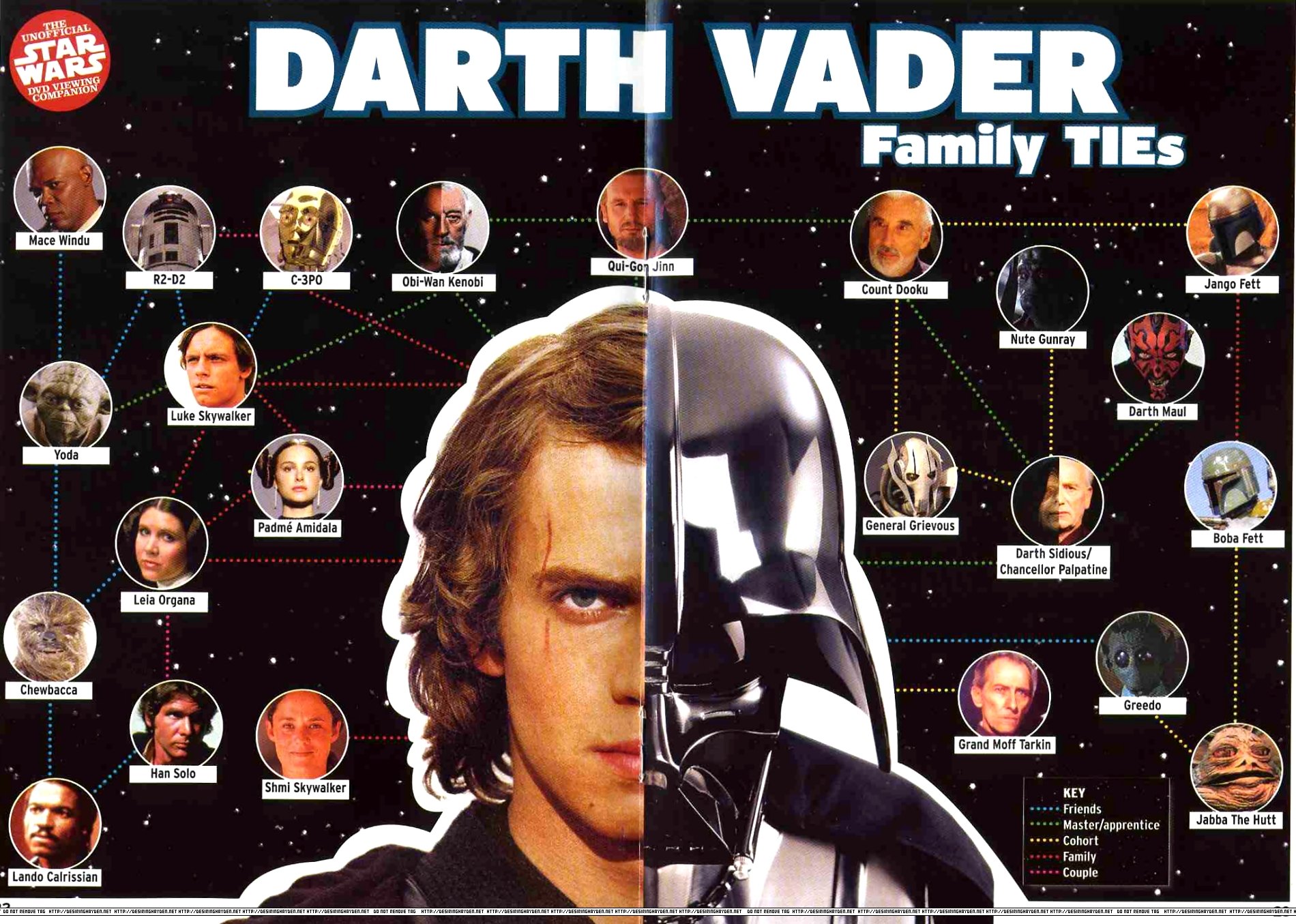
Now what if I told you that Star Wars, although super cool with the Millenium Falcon, the exploding of the Death Star, Darth Vader and Tatooine wasn't all that ground breaking? It's not! Obviously. No story is really that original, everything's been written before no? Star Wars certainly has it's own story line-enough to make 6 going on 7 movies plus television series like the Clone Wars and all that jazz-but alas it's nothing more than variations of various different OTHER stories written before.

One of Star Wars' most obvious characteristic is it's representation of fantastical archetypes such as knighthood, chivalry, princesses, royalty and the typical "epic hero". You could find elements of Julius Caesar, The Odyssey and maybe even Beowulf within Star Wars. The climax of the series' plot is influenced by the fall of the Roman Republic and rise of the Empire; although that's not a story, it's still a historical event that's happened and not made up out of Lucas' head necessarily. Lucas has been noted saying that he was also influenced by the Lord of the Rings trilogy which has a lot of biblical influence in regards to plot. Lucas was also admittedly heavily influenced by Akira Kurosawa's work such as The Hidden Fortress as well as Joseph Campbell's The Hero with a Thousand Faces. This is not to say Lucas is a plagiarist, just that he-like all writers-has only written a variation of stories told before him.
I was only able to present you with the influences I was able to source although I have have heard people speculate that Star Wars is based on stories in the bible, or government events, etc...which nobody's here to say it was or wasn't but none the less it was a groundbreaking, impressive film deserving of it's praise. It had more appeal than Star Trek due to it's more romantic, human, hero's as opposed to militaristic types. Star Wars also was less typical science fiction and more mythological and fantastical. So, in a way, Star Wars had more appeal due to it's more traditional less groundbreaking epicness. Guess it's better to recreate the old in a crazy new impressive way than to take too many risks?
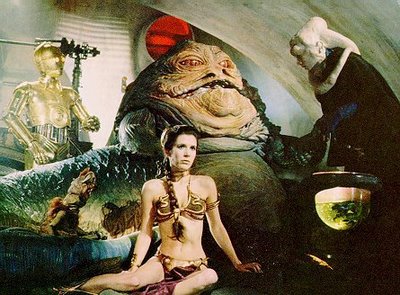
P.S.-I met Princess Leia. I have Carrie Fisher's autograph, someday I want a real, movie prop quality, light sabre. I get the nerd points this week.
P.P.S.-I suggest you watch this, it's actually pretty factual, and if you like LOTR you will enjoy this even more...I must warn you it has some rough language.....definite Parental Advisory rated R for language.
Tuesday, October 1, 2013
The Ice Queen
So my belly dancing troupe did this performance this past Sunday, September 30th, to this song called the "Ice Queen". Originally the instructor had this storyline she made up in her head she wanted to recreate through dance. She had everyone in the dance cast as some sort of character in the story about this princess who has this gift that these two evil women are trying to get from her but these angels are trying to protect her but get defeated by the evil ones. She never quite finished the story because by then I was added in the dance and messed up the story, plus the dance wasn't completed and she didn't quite figure out how to end the story in the form of dance. I wanted to examine how we perceive story through movement in a very simple way. Was movement the first way we told story? Was movement and spoken word the original storytelling way? Is that way we have "body language?"
Upon trying to research the answers to the questions I only ran into that "dance has told stories for thousands of years," and ballets. Ballets (in the work sense of the word) essentially are plays with nothing but movement just as operas are nothing but music. I suppose you could say that the answers to those questions respectively is yes, yes, and yes. A lot of what we know about body language (consider clicking the link I found it quite interesting but not able to mention a lot of the stuff in this single post) when communicating on a daily basis is greatly used in dancing. Body language is almost used more than spoken word when you think about it, how do we understand our pets and how they feel since they can't communicate in our language?I know I can only pick up on what my rabbit says by his body language because he doesn't make noises. We are getting off track here, sorry.
When doing a dance you are trying to express your story without words; you use your facial expressions and movement vocabulary over all else. If you stick your fist in the air you can convey either anger, success, joy, or maybe you won a battle but that all depends on your face. I find it unique how dance contrasts writing so much; in writing you are trying to convey a point without inflections of the voice, body language, or any visual aid of any kind. In dance you are doing the exact opposite, you are using the music and it's tone in sync with your body and that is all. So much can be told in a dance with no words at all. I guess it's so hard to elaborate on such a topic because most of it can only be explained by experiencing it.
Upon trying to research the answers to the questions I only ran into that "dance has told stories for thousands of years," and ballets. Ballets (in the work sense of the word) essentially are plays with nothing but movement just as operas are nothing but music. I suppose you could say that the answers to those questions respectively is yes, yes, and yes. A lot of what we know about body language (consider clicking the link I found it quite interesting but not able to mention a lot of the stuff in this single post) when communicating on a daily basis is greatly used in dancing. Body language is almost used more than spoken word when you think about it, how do we understand our pets and how they feel since they can't communicate in our language?I know I can only pick up on what my rabbit says by his body language because he doesn't make noises. We are getting off track here, sorry.
When doing a dance you are trying to express your story without words; you use your facial expressions and movement vocabulary over all else. If you stick your fist in the air you can convey either anger, success, joy, or maybe you won a battle but that all depends on your face. I find it unique how dance contrasts writing so much; in writing you are trying to convey a point without inflections of the voice, body language, or any visual aid of any kind. In dance you are doing the exact opposite, you are using the music and it's tone in sync with your body and that is all. So much can be told in a dance with no words at all. I guess it's so hard to elaborate on such a topic because most of it can only be explained by experiencing it.
Subscribe to:
Posts (Atom)